
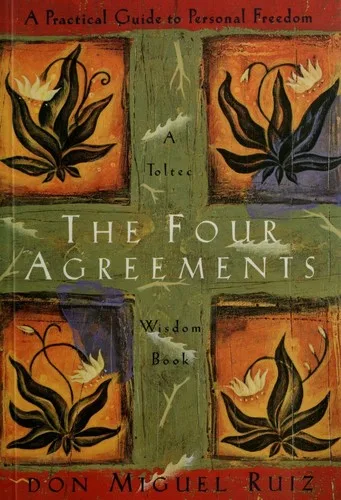
The Four Agreements is a short book with a big readership. Don Miguel Ruiz published it in 1997, framing it as Toltec wisdom from the traditions of ancient Mexico. You can read it in an afternoon, and most people remember the four agreements and forget the argument underneath them.
That argument is the useful part. Ruiz says you were raised into thousands of agreements about who you are, what's good and what's shameful, and you never chose most of them. They run your reactions automatically. The four agreements are a replacement set, chosen on purpose.
This summary covers what the four agreements are, what each one looks like on a normal Tuesday, and how to practise them without turning them into four more rules to fail.
What are the four agreements?
- Be impeccable with your word.
- Don't take anything personally.
- Don't make assumptions.
- Always do your best.
Ruiz presents them as a set. Each makes the next easier: if you stop taking things personally, you have fewer reasons to make assumptions, and so on.
The idea underneath: domestication
Ruiz calls the way we're raised domestication. As children we're rewarded for adopting the beliefs of the people around us and punished for breaking them. Over time we stop needing the outside rewards and punishments, because we carry an inner Judge that applies the rules, and an inner Victim that takes the punishment.
He calls the collected beliefs of a society "the dream of the planet", and your personal set your "book of law". The problem isn't that you have agreements. It's that many of yours were installed before you could question them, and some of them hurt you every day: that you're not good enough, that other people's opinions define you, that mistakes make you worthless.
Apply it: write down one belief about yourself you'd never say to a friend about them. That's an old agreement. The four new ones are how you replace it.
1. Be impeccable with your word
Ruiz puts this first because he treats the word as the most powerful tool you have. "Impeccable" in his sense means without sin against yourself: speaking with integrity, saying only what you mean, and not using words to put yourself or others down.
It covers more than lying. It includes gossip, which Ruiz sees as spreading poison, and the running commentary you aim at yourself. Calling yourself an idiot after a mistake is a breach of this agreement too.
Apply it: for one day, notice every time you speak badly about someone who isn't in the room, including yourself. Don't fix it yet. Just count.
2. Don't take anything personally
What other people say and do is a projection of their own reality, their own dream in Ruiz's language. Their insult says something about their beliefs and their day. It isn't a verdict on you.
The book's point is that this works both ways. Praise isn't about you either. If you need other people's approval to feel good, you're equally exposed to their disapproval. Not taking things personally gives you immunity to both.
This isn't the same as ignoring feedback. You can still judge whether a criticism is useful. You just stop treating it as a statement about your worth.
Apply it: next time a comment stings, ask "What does this say about their world?" before you ask "What does this say about me?"
3. Don't make assumptions
We assume what people think, why they did something and what they meant, and then we react to our assumption as if it were fact. Ruiz traces a large share of conflict, in relationships and at work, to this gap between what was said and what we decided it meant.
His fix is plain: ask questions, and say what you want clearly. If you don't understand, ask. If you want something, ask for it. Assuming someone should know what you need is still an assumption.
Apply it: pick one situation that's bothering you right now. Write down the story you've told yourself about it. Then write the one question that would test it, and ask it.
4. Always do your best
The fourth agreement holds the other three together. Your best will vary: tired, ill or stressed, it's lower than on a good day. That's fine. The agreement is to do your best under the conditions you have, no more and no less.
Doing less leaves you with regret. Trying to do more than your best burns you out. Doing your best, as it is today, removes the reason for the inner Judge to punish you, because you can't do better than your best.
Ruiz also links it to action. Doing your best means acting, not just agreeing with the ideas. The agreements only change anything if you practise them, and you'll break them often while you learn.
Apply it: at the end of today, ask one question: "Did I do my best with what I had?" If yes, the day is closed. If no, name one thing for tomorrow and stop there.
Join the free list for new syntheses.
One book's 20%, with the prompts to apply it.
Free. No spam.
The fifth agreement
Ruiz later wrote The Fifth Agreement with his son, Don Jose Ruiz, adding a fifth: be sceptical, but learn to listen. It's a fitting addition, and a useful lens for this book too. Take what helps and test it against your own life.
Where the book overreaches
Two honest caveats. The Toltec framing is a spiritual teaching device, not historical scholarship, so read the book as practical philosophy rather than anthropology. And the agreements are easy to state and hard to live, which can make them feel like a standard you're failing. Ruiz's own answer is the fourth agreement: practise, slip, start again. Treat them as a direction, not a pass or fail test.
Do this today
- Count your words against yourself for one day.
- Reframe one sting: what does it say about their world?
- Test one assumption with a direct question.
- Close the day by asking whether you did your best with what you had.
3 prompts to go deeper
- "Here's a situation that upset me: [describe it]. Help me separate what actually happened from the assumptions I made about it."
- "I keep telling myself [belief]. Where might I have learned this, and what would I choose to believe instead?"
- "Help me write a short, honest request for what I need from [person], without assuming they should already know."
FAQ
What are the four agreements?
Be impeccable with your word, don't take anything personally, don't make assumptions, and always do your best. Don Miguel Ruiz presents them as a set of personal agreements to replace the self-limiting beliefs most people absorb growing up.
What is The Four Agreements about?
It argues that much of our suffering comes from beliefs and agreements we were taught as children and never questioned. The book offers four new agreements you choose on purpose, and explains how each one reduces conflict, self-judgement and fear of other people's opinions.
Who wrote The Four Agreements?
Don Miguel Ruiz. It was first published in 1997. He later wrote The Fifth Agreement with his son, Don Jose Ruiz.
Is The Four Agreements worth reading?
Yes, if you want a short, practical book on self-talk, conflict and other people's opinions. It takes an afternoon. The value is in practising one agreement at a time rather than in rereading the book.
Run it, don't just read it
Pick one agreement and practise it for a week before you add the next. If you want to build it as a daily habit, use the cue and tracking ideas in the Atomic Habits summary. For a Stoic take on the same ground, separating what's in your control from what isn't, read the Marcus Aurelius Meditations summary, and for staying present rather than living in the stories in your head, the Power of Now summary. To choose where your effort goes first, try the Find Your 20% focus audit.
For a story about pursuing what you want despite the fear, read the Alchemist summary, and for adapting when life changes around you, the Who Moved My Cheese summary.
The next synthesis, the week it drops.
Distilled, not summarized. Free.
Free. No spam.