
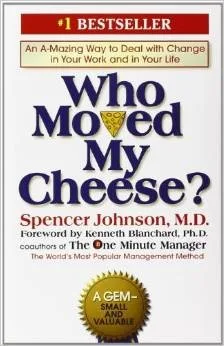
Who Moved My Cheese? is a parable you can read in under an hour. Spencer Johnson published it in 1998, and it became one of the best-known business books of its era, handed out by managers in offices going through mergers, restructures and layoffs.
The story is simple on purpose. The cheese stands for whatever you want from life: a job, a relationship, money, health or peace of mind. The maze is where you look for it. The question is what you do when the cheese moves.
This summary covers the story, the lessons, and the fair criticism of the book, so you can use the useful part without swallowing the rest.
What is Who Moved My Cheese about?
The four characters
Four characters live in a maze and look for cheese every day:
- Sniff, a mouse who notices change early.
- Scurry, a mouse who moves into action quickly.
- Hem, a little person who denies and resists change.
- Haw, a little person who learns to adapt once he sees the benefit.
The mice are simple. The little people are like us: they have complex beliefs and emotions, which help them in some ways and trap them in others.
Cheese Station C
All four find a huge supply of cheese at Cheese Station C. The mice keep their routine: they arrive early, check the cheese and stay alert. Hem and Haw get comfortable. They move their lives around the cheese, start to see it as theirs, and stop paying attention.
The cheese runs low gradually. The mice notice. The little people don't.
The cheese is gone
One day the station is empty. Sniff and Scurry aren't surprised: they'd noticed the supply shrinking, so they head straight back into the maze to look for more.
Hem and Haw are shocked. Hem is outraged and insists it isn't fair. They come back day after day, hoping the cheese will return, and they get weaker and more frustrated.
Haw goes into the maze
Eventually Haw laughs at himself, realises nothing will change while they wait, and heads into the maze on his own. Hem refuses to come.
As he goes, Haw writes what he's learning on the walls of the maze, partly for himself and partly in the hope that Hem will follow. He finds bits of cheese, loses his fear as he moves, and finally reaches Cheese Station N, full of new cheese, where Sniff and Scurry are already settled. Hem's fate is left open.
The book frames the story with a reunion of former classmates, who discuss afterwards how it applies to their own careers and families.
The lessons on the wall
Haw's notes are the book's takeaways. In plain terms:
- Change happens. The cheese keeps moving, whether or not you think it should.
- Anticipate change. Expect the cheese to move, and get ready.
- Monitor change. Check the cheese often, so you know when it's getting old.
- Adapt quickly. The sooner you let go of the old cheese, the sooner you enjoy the new.
- Change. Move with the cheese.
- Enjoy change. Savour the adventure and the taste of new cheese.
- Be ready to change again. The cheese will keep moving.
The most famous line asks what you would do if you weren't afraid. It's the question that gets Haw out of the empty station.
Apply it: name your cheese. What are you depending on right now (a client, a role, a skill, a platform) that could move?
Join the free list for new syntheses.
One book's 20%, with the prompts to apply it.
Free. No spam.
The useful 20%
Watch the small signals
The mice aren't smarter than the little people. They just keep checking. The cheese at Station C didn't vanish overnight; it shrank while Hem and Haw stopped looking. The practical habit is to review the things you depend on before they run out.
Apply it: set a monthly ten-minute check on your main source of income or opportunity. Is it growing, flat or shrinking?
Fear is bigger in your head
Haw's fear is worst before he moves. Once he's in the maze, imagining the new cheese, he feels better even before he finds it. The book's claim is that what you fear is rarely as bad as the picture you've made of it.
Apply it: write down the worst realistic outcome of the change you're avoiding, and one thing you'd do if it happened.
Hem is the cautionary tale
Hem isn't lazy. He's loyal to a situation that no longer exists. That's the trap the book wants you to recognise in yourself: treating "how it used to be" as how it should be.
The fair criticism
The book has critics, and they're worth hearing. Some readers see it as a corporate tool, handed out to make employees accept layoffs and restructures without asking whether the change is fair or well run. The story has no room for questioning who moved the cheese, or whether they should have.
Both things can be true. Adapting to change you can't control is a useful skill. So is challenging change you can influence. Use the book for the first, and don't let it talk you out of the second.
Do this today
- Name your cheese, the thing you depend on most right now.
- Check it: growing, flat or shrinking?
- Answer the question: what would you do if you weren't afraid?
- Take one step into the maze before the end of the week.
3 prompts to go deeper
- "Here's what I depend on for income or opportunity: [describe it]. What early signs would tell me it's starting to shrink?"
- "I'm resisting this change: [describe it]. Help me separate what's genuinely unfair from what I just don't like."
- "What would I do about [situation] if I weren't afraid? Give me three options, from smallest to boldest."
FAQ
What is Who Moved My Cheese about?
It's a short parable about change. Two mice and two little people live in a maze and depend on a supply of cheese. When the cheese disappears, the mice adapt straight away, one little person refuses to move, and the other learns to let go and find new cheese.
What does the cheese represent?
Whatever you want from life or depend on: a job, a relationship, money, health, status or peace of mind. The maze is where you look for it.
Who wrote Who Moved My Cheese?
Spencer Johnson, also co-author of The One Minute Manager. It was published in 1998. A sequel, Out of the Maze, was published in 2018.
Is Who Moved My Cheese worth reading?
It takes under an hour, and the lessons on change are useful. Read it alongside its criticism: it's good on adapting to change, and silent on challenging change that's badly handled.
Run it, don't just read it
The book is about noticing and moving. To decide where your effort should go next, run the Find Your 20% focus audit. For a deeper look at the mental shortcuts that make change feel scarier than it is, read the Thinking, Fast and Slow summary. And if the change you need is a new routine, the Atomic Habits summary shows how to make it stick.
For another fable about the fear that stops people going after what they want, read the Alchemist summary.
The next synthesis, the week it drops.
Distilled, not summarized. Free.
Free. No spam.