
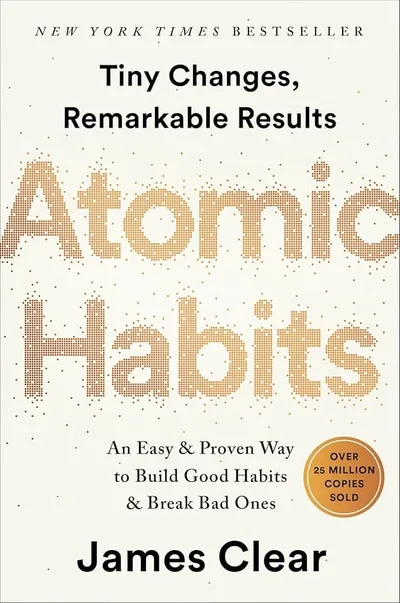
Most people read Atomic Habits and walk away thinking it's about the Four Laws of Behaviour Change. Make it obvious. Make it attractive. Make it easy. Make it satisfying.
That's useful. But it's not the part that changes your life.
The part that changes your life sits underneath: two ideas James Clear builds the whole book around, which most readers skim past. Over 25 million copies later, they're still the ideas people miss. This is the 20% worth the whole book: those two ideas first, then the Four Laws and the handful of tactics that make them stick.
You don't rise to your goals. You fall to your systems.
Clear opens with a deceptively simple maths problem.
Get 1% better every day for a year. You don't end up 365% better. You end up 37 times better. That's the compound effect applied to behaviour. (Run your own numbers.)
But here's the part most summaries leave out: it works in reverse too. Get 1% worse each day and you decline to nearly zero.
This isn't motivational fluff. It's the reason small habits feel pointless in the moment but devastating — or transformative — over time. Clear calls it the "Aggregation of Marginal Gains," borrowed from British cycling coach Dave Brailsford, who used this exact principle to turn a struggling team into Olympic gold medalists.
The takeaway isn't "try harder." It's that your outcomes are a lagging measure of your habits. Your bank account reflects your financial habits. Your weight reflects your eating habits. Your knowledge reflects your learning habits.
Winners and losers often have the same goals. The difference is the system behind the goal. A goal is a one-time target. A system is the machine that keeps producing results long after the goal is hit. If you're a writer, your goal might be to finish a book; your system is writing 500 words every morning. The system is what survives.
As Clear puts it: "You do not rise to the level of your goals. You fall to the level of your systems."
The real game: identity, not outcomes
Clear describes three layers of behaviour change, arranged like concentric circles:
- Outcomes — what you get (lose 10kg, earn more money)
- Processes — what you do (go to the gym, write daily)
- Identity — what you believe about yourself
Most people start with outcomes. "I want to lose weight." Then they work backwards to the process. This is why most habit changes fail — they're built on willpower, not belief.
Clear's argument is to flip the order. Start with identity.
Don't say "I want to run a marathon." Say "I'm a runner." Don't say "I want to read more." Say "I'm a reader."
The shift sounds small. It's not. When your identity drives the habit, you don't need motivation. You act consistently because that's who you are. A person who identifies as healthy doesn't need willpower to skip the second slice of cake — it just doesn't fit who they are. Every rep at the gym, every page you read, every early morning is a vote. As those votes stack up, your self-image shifts to match.
"Every action you take is a vote for the type of person you wish to become. No single instance will transform your beliefs, but as the votes build up, so does the evidence of your new identity."
Two steps to make it work:
- Decide the type of person you want to be. Not the outcome. The person.
- Prove it to yourself with small wins. Not grand gestures. Tiny evidence, repeated.
The Four Laws of Behaviour Change
Every habit runs the same loop: Cue → Craving → Response → Reward. Clear turns each step into a law for building a good habit.
- Make it obvious (cue)
- Make it attractive (craving)
- Make it easy (response)
- Make it satisfying (reward)
To break a bad habit, invert each law: make it invisible, unattractive, difficult and unsatisfying. This framework is the operating system of the book. Once you learn it, you'll see every habit in your life through it — and you'll know which lever to pull.
The tactics that make the laws work
Habit stacking. Link a new habit to one you already do: "After I [current habit], I will [new habit]." After I pour my morning coffee, I will write one sentence in my journal. The trigger is built in, so you never decide when. Stack three or four and you've built a morning routine without a motivational speech.
Environment design. Your environment shapes your behaviour more than willpower ever will. Want to read more? Put a book on your pillow. Want to eat better? Put fruit on the counter and hide the chips. People with "good self-control" aren't better at resisting temptation — they've designed their lives so they face less of it.
The two-minute rule. Any new habit should take less than two minutes to start. "Read before bed" becomes "read one page." "Go for a run" becomes "put on your running shoes." The goal is to show up; mastery comes later. Once you start, you usually keep going, and even when you don't, you've reinforced the identity of someone who shows up.
Temptation bundling. Pair something you need to do with something you want to do. Only watch Netflix on the exercise bike. Only check social media after you've written 200 words. You're not fighting the craving. You're channelling it.
The Goldilocks Zone. Habits stick when they're not too easy and not too hard. If you're bored, make it harder. If you're anxious, make it easier. It's why people quit the gym after January: zero to five days a week hits a wall. Start at the edge of your ability and nudge it forward.
Never miss twice. You will miss days. The rule isn't perfection, it's recovery. One miss is an accident. Two is the start of a new habit you don't want. The difference between someone who stays fit and someone who falls off isn't that one never misses — it's that they never miss twice.
Do this today
- Pick one identity statement. "I'm the type of person who ___." Choose who you want to become, not what you want to achieve.
- Find the smallest possible action that proves it. One pushup. One page. One healthy meal.
- Stack it onto something you already do every morning.
- Redesign one space so the right behaviour is the path of least resistance.
- Track the votes, not the results. Compounding is invisible for months. The results are lagging indicators.
- If you miss a day, don't miss two.
3 prompts to go deeper
- "If I applied the 1% rule to my biggest goal right now, what's the smallest daily action that compounds?"
- "What identity am I reinforcing with my current habits — and is it the one I actually want?"
- "Where am I relying on motivation instead of environment design?"
Run it, don't just read it
A summary tells you what the book says. The Atomic Habits Notion template and the free Atomic Habits Action Vault turn it into workbooks, prompts and a tracker you actually use. Or see what 1% a day compounds to with the Atomic Habits Calculator.
It's on our lists of the best books for content creators, best books for managers and best books for personal growth. For the long view of how small, repeated practice turns into mastery, read the Outliers summary. Prefer paper? Get the free Atomic Habits workbook, the Atomic Habits summary PDF and the printable habit trackers.
The next synthesis, the week it drops.
Distilled, not summarized. Free.
Free. No spam.