
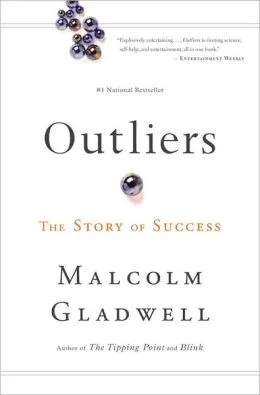
Outliers: The Story of Success is Malcolm Gladwell's 2008 book about why some people achieve far more than others. Its answer pushes against the self-made story. Talent and effort matter, Gladwell argues, but they're not enough on their own: outliers are also the product of opportunity, timing and cultural inheritance.
It's also the book that made the 10,000-hour rule famous, which is why it's worth reading carefully. This summary covers the main ideas and what the research behind the rule actually says.
Part one: opportunity
The Matthew effect
Gladwell opens with Canadian ice hockey. Elite players are disproportionately born in the first months of the year. The reason is the age cut-off for youth leagues: children born just after it are the oldest, and therefore the biggest, in their group. They get picked for better teams, receive better coaching and play more games, so a small early advantage compounds into a real one.
Sociologists call this accumulative advantage, or the Matthew effect: to those who have, more is given.
Apply it: look for small early advantages you could create for yourself or your team: a bit more practice, earlier exposure, better feedback. They compound.
The 10,000-hour rule
Gladwell's best-known chapter draws on research by psychologist Anders Ericsson, who studied violinists at a music academy in Berlin. The best performers had practised far more by around age 20 than the merely good ones, and Gladwell turned the average figure into a rule of thumb: about 10,000 hours of practice to reach world-class skill.
He adds examples: the Beatles playing hours-long sets night after night in Hamburg before they became famous, and Bill Gates getting rare access to a computer terminal as a teenager, giving him thousands of hours of programming before most people had touched a computer.
What the research actually says
The rule is more nuanced than the slogan. Ericsson himself said Gladwell oversimplified his work:
- 10,000 was an average, not a threshold. Some people got there faster, some slower, and the number varies widely by field.
- The type of practice matters. Ericsson's point was about deliberate practice: focused work on specific weaknesses, with feedback. Hours of comfortable repetition don't count the same way.
- Practice isn't the only factor. A large 2014 meta-analysis found that deliberate practice explains part of the differences in skill, but far from all of it, and much less in some fields than others.
The useful takeaway still stands: mastery takes years of the right kind of work. To see what that means at your pace, try the 10,000-hours calculator.
Timing
Gladwell argues that when you're born can put you in the right place at the right moment. Many of the richest people in history were born within a few years of each other in the 1830s, positioned for America's industrial boom. Several founders of the personal computer era were born in the mid-1950s, old enough to seize the moment and young enough to take the risk.
Join the free list for new syntheses.
One book's 20%, with the prompts to apply it.
Free. No spam.
Practical intelligence
Gladwell compares Chris Langan, a man with an extraordinarily high IQ who struggled to get through college, with physicist Robert Oppenheimer, who talked his way out of serious trouble as a student. The difference, he argues, was practical intelligence, knowing how to talk to people in power and ask for what you need, which children from some backgrounds are taught deliberately and others aren't.
Apply it: practical intelligence is learnable. Practise asking for what you need clearly, especially from people with authority.
Part two: legacy
Culture and speaking up
The second half of the book argues that cultural inheritance shapes behaviour long after people leave the place it came from. Gladwell's most discussed example is airline safety: he links a series of crashes to cultural differences in how junior crew speak to captains, and describes how one airline improved after changing cockpit culture so that junior officers spoke up clearly.
Rice paddies and maths
He also explores why students from some East Asian cultures do well at maths, pointing to the language of numbers and to a cultural legacy of persistence associated with intensive rice farming. He links the theme to schools that extend learning time, and to research suggesting that much of the achievement gap between richer and poorer children opens up over summer holidays.
How to read Outliers
Gladwell is a storyteller, and his stories are chosen to make a point. Some of his interpretations are contested, so treat the book as a set of lenses rather than proven laws. The central lens holds up well: success has a context, and you can shape some of it.
Do this today
- Estimate your hours in the skill you care about most.
- Make one practice session deliberate: pick a weakness and get feedback.
- Create one small advantage that will compound.
- Ask clearly for one thing you need from someone senior.
3 prompts to go deeper
- "I want to get much better at [skill]. Design a weekly deliberate practice plan that targets my weaknesses and builds in feedback."
- "What small early advantages could I create for myself in [field], and how would they compound over five years?"
- "Here's my situation: [describe it]. What timing or opportunity am I in a good position to use right now?"
FAQ
What is Outliers about?
Malcolm Gladwell argues that exceptional success comes not only from talent and hard work, but from opportunity, timing and cultural background. He uses examples from ice hockey, music, software and aviation to show how hidden advantages compound.
What is the 10,000-hour rule in Outliers?
Gladwell's rule of thumb that world-class skill takes around 10,000 hours of practice, based on Anders Ericsson's research on violinists. Ericsson later said the figure was an average rather than a threshold, and that the kind of practice matters more than the total.
Who wrote Outliers?
Malcolm Gladwell, also the author of The Tipping Point and Blink. Outliers was published in 2008.
Is the 10,000-hour rule true?
Partly. Reaching expert level does take years of focused practice, but the hours needed vary widely by person and field, and research finds practice explains only part of the differences in skill.
Run it, don't just read it
Turn the hours into a timeline with the 10,000-hours calculator, and see how many weeks you have to spend on it with the life clock. To make the daily practice automatic, read the Atomic Habits summary, and for the focus it takes, the Deep Work summary.
The next synthesis, the week it drops.
Distilled, not summarized. Free.
Free. No spam.