
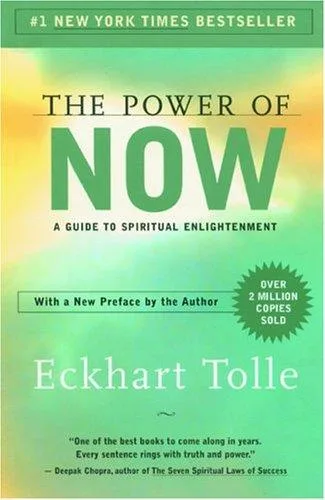
The Power of Now is a spiritual book that a surprising number of founders and operators keep on their shelf. Eckhart Tolle first published it in 1997, and it reads in places like a teacher answering questions, because much of it is written that way.
You don't have to accept the metaphysics to get value from it. Strip the language back and the practical core is simple: most stress comes from a mind that won't stay in the present, and you can train it to come back.
This Power of Now summary keeps that core: the 20% you can practise this week.
You are not your mind
Tolle's starting point is the voice in your head: the running commentary that judges, worries, rehearses and replays. Most people, he argues, are so identified with that voice that they think it's them.
The way out is watching the thinker. Notice a thought as it happens, without judging it, and you've stepped outside it. In that moment there's a gap: awareness without the commentary. Tolle calls this presence, and the book is mostly about widening that gap.
Apply it: set a one-minute timer and simply notice each thought as it arrives, labelling it "thinking". The point isn't to stop thoughts. It's to see that you're the one noticing them.
Clock time versus psychological time
Tolle draws a distinction that's useful even for the most practical reader:
- Clock time is the practical use of past and future: planning a project, learning from a mistake, setting a deadline.
- Psychological time is identification with the past and future: ruminating over what went wrong, living in anxious rehearsal of what might.
His claim is that the present moment is the only place life actually happens, and that most suffering is psychological time. Clock time is fine. The trouble starts when you stay in the plan.
Goals are fine in this view. The trouble is when the goal matters so much that the present step becomes nothing more than a means to an end, something to get through. Then you're always on the way, never here.
Tolle has a blunt question for these moments: do you have a problem right now, this second? Usually the answer is no. There's a situation to deal with, now or later, and a mind busy turning it into a problem.
Apply it: plan in a fixed block, write the plan down, then return your attention to the task in front of you. When worry pulls you forward, ask: is there anything I can do about this right now?
The pain-body
Tolle's most distinctive idea is the pain-body: accumulated old emotional pain that lies dormant and then gets triggered, flooding you with a reaction far bigger than the situation deserves. It feeds on more negativity: conflict, drama, resentment.
Whatever you think of the term, the practice is sound. Notice the reaction as a reaction. Name it rather than acting from it, and it loses much of its grip.
Join the free list for new syntheses.
One book's 20%, with the prompts to apply it.
Free. No spam.
Surrender is not giving up
The word "surrender" puts many readers off, but Tolle means something specific: accepting what is, in this moment, instead of mentally fighting it. Resistance adds a second layer of suffering on top of the situation itself: the stuck traffic plus the fury about the traffic.
Acceptance isn't passivity. You can accept that a project has failed and then act decisively to fix it. Tolle's point is that action taken from acceptance is clearer than action taken from resistance.
Apply it: next time something goes wrong, say "this is what's happening" before you decide what to do about it. Then act.
Relationships as practice
A late chapter of the book applies all of this to relationships. Tolle argues that much of what passes for love is need: the relationship flips between attraction and conflict because each person is looking to the other to fill a gap. His alternative is presence. Listen without the running commentary, notice your own reactions as they arise, and stop needing to be right.
Apply it: in your next disagreement, notice the urge to defend your position, and listen fully for one more minute before you answer.
Entry points into presence
Tolle offers a few simple doorways back into the present:
- Feel the inner body. Put your attention on the sensation of your hands or breath.
- Notice the gaps. The pause between thoughts, or between breaths.
- Use waiting time. Queues, lifts and loading screens become practice instead of irritation.
None of this needs a cushion or an hour a day. It's built for moments.
A sceptic's reading
Two cautions keep the book useful. Tolle's claims about consciousness and the nature of the self are spiritual, not scientific, and the book doesn't test them. And the language can be repetitive. Take the practices and leave the cosmology if it doesn't fit you. They overlap heavily with mindfulness and with Stoic philosophy, which arrived at similar habits two thousand years earlier; see the Marcus Aurelius Meditations summary.
Do this today
- One minute of watching thoughts. Label each one "thinking" and let it go.
- Plan once, then return. Write today's plan in a fixed block and stop rehearsing it.
- Name one reaction today instead of acting from it.
- Turn one wait into practice. Breathe and notice, instead of reaching for your phone.
3 prompts to go deeper
- "Here's what I'm worried about: [describe it]. Which parts are clock time I can act on, and which are psychological time?"
- "Help me design a two-minute presence practice I can do between meetings."
- "What situation am I resisting right now, and what action would I take if I accepted it first?"
FAQ
What is The Power of Now about?
It argues that the present moment is the only place life happens, that most suffering comes from identifying with thoughts about the past and future, and that you can step out of that by observing your mind and accepting what is.
What is the pain-body in The Power of Now?
Tolle's term for accumulated old emotional pain that gets triggered and produces reactions out of proportion to the situation. The practice is to notice it as it arises rather than acting from it.
Is The Power of Now worth reading?
Yes, for the practices, especially watching your thoughts and separating clock time from psychological time. If the spiritual framing doesn't suit you, the practical chapters still stand on their own.
What does "the power of now" mean?
That the present moment is the only point where you can actually act or experience anything. The past exists only as memory and the future only as anticipation. Bringing your attention back to now is where Tolle locates both peace and effective action.
Who wrote The Power of Now?
Eckhart Tolle. It was first published in 1997.
Run it, don't just read it
A summary tells you what the book says. The value comes from practising one entry point until it's automatic. To turn presence into focused work, read the Deep Work summary. To make a practice stick, see the Atomic Habits summary. For the method of turning a book into a system, see the free Atomic Habits Action Vault and the free tools.
It's on our list of the best books for personal growth. For four practical rules that work on the same inner noise, read the Four Agreements summary, and for a fable about following what you want, the Alchemist summary.
The next synthesis, the week it drops.
Distilled, not summarized. Free.
Free. No spam.