
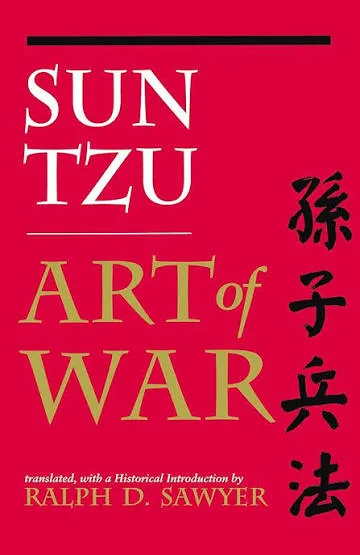
The Art of War is more than two thousand years old, traditionally credited to Sun Tzu, a military strategist in ancient China. It's short: thirteen chapters, many of them a few pages long. And it has outlived nearly every strategy book written since.
The reason isn't the military detail. It's that the book treats conflict as something to be won with thinking, not force. Read with "competitor" in place of "enemy" and "market" in place of "terrain", most of it still applies.
Translations differ a lot, so the ideas below are paraphrased rather than quoted. This Art of War summary keeps the 20% that works outside a battlefield.
Win without fighting
Sun Tzu's central claim is that the highest skill is to win without fighting at all. Fighting is expensive even when you win. The best strategist makes the battle unnecessary.
He ranks the options in Chapter 3. Best is to defeat the enemy's strategy. Next best is to break up their alliances. After that comes attacking their army in the field. Worst of all is besieging walled cities, the slow, costly frontal assault.
Apply it: before you compete head-on on price or features, ask whether you can make the contest irrelevant: a different position, a partner who changes the field, or a customer the competitor can't serve.
Know the enemy and know yourself
The book's most famous idea comes in three parts. If you know your opponent and yourself, you needn't fear the outcome of a hundred battles. If you know yourself but not the opponent, you'll win some and lose some. If you know neither, you'll lose every time.
Note that self-knowledge carries equal weight. Most failed strategies aren't beaten by a clever rival. They fail because someone overrated their own strengths.
Apply it: write one page on your main competitor (what they're good at, what they can't afford to do) and one honest page on yourself. Then compare.
Win first, then fight
Sun Tzu observes that victorious armies win first and then seek battle, while defeated armies fight first and hope to win. The outcome is set by preparation, position and calculation before any contact.
In Chapter 1 he lists the factors to weigh before committing, including the moral cause, the conditions, the ground, the commander and discipline. Whoever has more of them in their favour usually wins.
Chapter 4 adds the defensive half. Good fighters first make themselves impossible to defeat, then wait for the opponent to give them an opening. Not losing is in your own hands. Winning depends on the other side's mistakes.
Apply it: before a pitch, launch or negotiation, decide what has to be true for you to win, and secure as much of it as you can beforehand. Pre-sell, line up allies, pick your timing.
All warfare is based on deception
Sun Tzu is blunt: appear weak when you're strong, far away when you're near, unready when you're ready. Control what the other side sees.
Outside war, take the defensive lesson first. Don't telegraph your next move, and don't take what a competitor shows you at face value.
Join the free list for new syntheses.
One book's 20%, with the prompts to apply it.
Free. No spam.
Speed, cost and knowing when to stop
Chapter 2 is about the cost of war. Long campaigns drain resources, morale and the people who pay for them. Sun Tzu's advice is to favour a decisive result over a drawn-out one, and to make the campaign pay for itself where possible.
Apply it: projects that drag on cost more than their budget says. Set a clear finish line, and if a fight has become a war of attrition, look for the exit or a different battle.
Be like water
In Chapter 6 Sun Tzu compares a good army to water. Water flows away from high ground and into low places; an army should avoid strength and strike weakness. And just as water has no constant shape, there are no constant conditions in conflict. A strategy that worked last year can fail this year.
Chapter 5 adds a related idea: use direct methods to engage and indirect ones to win. The expected move holds the other side in place; the unexpected one decides the outcome. In business terms, the obvious offer gets you in the room, and the angle nobody saw coming wins the deal.
Apply it: review your plan whenever the ground changes: a new competitor, a new channel, a new rule. Rigid plans break; adaptable ones find the gap.
Information is the edge
The last chapter is about spies, and its argument is about information. Sun Tzu says foreknowledge can't be had from omens or by guessing from past experience. It has to come from people who actually know the other side's situation. A general who won't spend to get good information, he says, is failing the people who depend on him.
Apply it: before your next big move, get your information first-hand. Talk to customers, read the reviews of the competitor you're up against, and ask the people closest to the market what they're seeing.
The 13 chapters
The chapter titles below follow Lionel Giles's 1910 English translation. Other translations word them differently.
- Laying Plans
- Waging War
- Attack by Stratagem
- Tactical Dispositions
- Energy
- Weak Points and Strong
- Maneuvering
- Variation in Tactics
- The Army on the March
- Terrain
- The Nine Situations
- The Attack by Fire
- The Use of Spies
Do this today
- Find one fight you can avoid by changing position instead of competing head-on.
- Write the two pages: your competitor, then yourself, honestly.
- List what must be true to win your next big pitch, and secure one item this week.
- Set a finish line on a project that's dragging.
3 prompts to go deeper
- "Here's my market and main competitor: [describe it]. How would Sun Tzu win here without competing head-on?"
- "Here's my plan: [describe it]. Where am I attacking strength instead of weakness?"
- "What do I believe about my own strengths that a competitor would dispute?"
FAQ
What is the main idea of The Art of War?
Conflict is won by strategy, preparation and knowledge rather than force. The best outcome is to win without fighting. Failing that, know yourself and your opponent, choose your ground, and avoid strength while striking weakness.
Who wrote The Art of War?
It's traditionally credited to Sun Tzu, a military strategist of ancient China. Historians still debate exactly when and by whom the text was written.
How many chapters are in The Art of War?
Thirteen, each covering one aspect of strategy, from planning and the cost of war to terrain and the use of spies.
Is The Art of War relevant for business?
Its specifics are military, but its principles of preparation, positioning, knowing the competition and avoiding costly head-on battles translate directly to business strategy and negotiation.
Run it, don't just read it
A summary tells you what the book says. The value comes from applying one principle to one real decision. For a modern study of how power plays out between people, read the 48 Laws of Power summary. For the long game of working with people rather than against them, see the 7 Habits of Highly Effective People summary. For the method of turning a book into a system, see the free Atomic Habits Action Vault and the free tools.
It's on our lists of the best books for consultants and best books for managers. For modern leadership lessons from combat, read the Extreme Ownership summary, and for strategy in business, the Good to Great summary.
The next synthesis, the week it drops.
Distilled, not summarized. Free.
Free. No spam.