
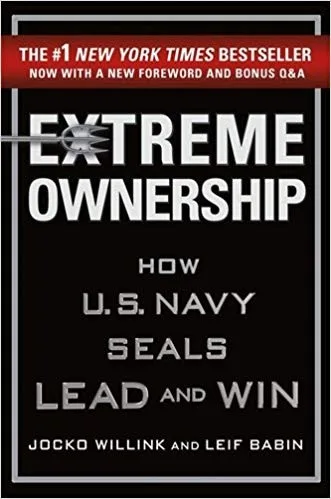
Extreme Ownership is a leadership book written by two former US Navy SEAL officers. Jocko Willink and Leif Babin led SEAL Team Three's Task Unit Bruiser during the Battle of Ramadi in Iraq in 2006, then built a leadership consultancy and wrote the book in 2015.
The format is consistent. Each of the 12 chapters tells a combat story, states the principle, then shows it applied in a business the authors advised. It reads fast, and the core message is in the title: as a leader, you own everything in your world.
This summary keeps the principles that change how you run a team, and the one caveat worth remembering.
The 12 principles
The book has three parts.
Part I: Winning the war within
- Extreme ownership
- No bad teams, only bad leaders
- Believe
- Check the ego
Part II: The laws of combat
- Cover and move
- Simple
- Prioritise and execute
- Decentralised command
Part III: Sustaining victory
- Plan
- Leading up and down the chain of command
- Decisiveness amid uncertainty
- Discipline equals freedom
Extreme ownership
The opening story is the hardest one in the book. During an operation in Ramadi, a friendly-fire incident left one SEAL wounded and an Iraqi soldier dead. In the debrief, Willink listed the mistakes several people had made, then said the fault was his, as the senior leader. Instead of losing his team's trust, he kept it.
The principle: the leader is responsible for everything that affects the mission. If a team member underperforms, the leader didn't train, explain or support them well enough. Blaming people, circumstances or other teams solves nothing, because you can only fix what you own.
Apply it: take the last thing that went wrong on your team. Write down what you could have done differently, even if someone else made the visible mistake.
No bad teams, only bad leaders
In SEAL training, boat crews race each other carrying heavy rubber boats. The authors describe the best and worst crews swapping leaders. The crew that had come last started winning races under its new leader, while the previously winning crew stayed competitive. The people hadn't changed. The leadership had.
Their line on standards: it's not what you preach, it's what you tolerate. If you accept poor performance without consequences, that becomes the standard.
Apply it: list one thing your team does that you dislike and haven't addressed. That's your current standard.
Believe, and check the ego
To lead people through a plan, you have to believe in it. If you don't understand why a decision was made, ask up the chain until you do, because you can't convince your team of something you don't believe.
Ego is the opposite force. It makes leaders defend bad plans, ignore advice and compete with their own colleagues. The authors argue that confidence is necessary, and ego that blocks learning is fatal.
Join the free list for new syntheses.
One book's 20%, with the prompts to apply it.
Free. No spam.
Cover and move
In combat, one team moves while another covers it, and they swap. The business lesson is that departments and teams are on the same side. If another team is failing, helping it succeed is part of your mission, not a distraction from it.
Simple
Complex plans fall apart under pressure. Plans and orders should be simple enough that everyone understands their part and can explain it back. If people can't, the plan is too complicated.
Apply it: ask someone on your team to explain the current priority in two sentences. If they can't, simplify it.
Prioritise and execute
When several problems hit at once, the authors' rule is to relax, look around and make a call: pick the highest priority, explain it clearly, put everything into it, then move to the next. Trying to solve everything at once usually means solving nothing.
Apply it: next time you feel overwhelmed, write down every problem, circle one, and work only on that until it's handled.
Decentralised command
No leader can control everything. Teams work best in small units, with junior leaders who understand the intent behind the mission well enough to make decisions without asking. That only works if the senior leader explains the why and trusts people to act.
Plan, lead up and decide
Planning means analysing the mission, spreading the work and preparing for what could go wrong. Leading up the chain means keeping your own boss informed, and if they don't support you, assuming you haven't given them what they need. Decisiveness means accepting that you'll rarely have full information. Waiting for certainty is itself a decision, and often the wrong one.
Discipline equals freedom
Willink's best-known idea closes the book. Discipline in routines, preparation and standards doesn't restrict you. It gives you the freedom to adapt when things change, because the basics are already handled.
The caveat
The authors also stress balance: extreme ownership is not doing everything yourself, and taking responsibility isn't the same as taking all the credit or all the work. Their follow-up book, The Dichotomy of Leadership, is about exactly that tension. Own the outcome, delegate the work.
Do this today
- Own one recent failure in writing, including your part in it.
- Name one standard you've been tolerating.
- Test your plan: can someone explain it back in two sentences?
- When it's chaos, pick one priority and execute it.
3 prompts to go deeper
- "Here's a problem on my team: [describe it]. What part of it do I own, and what would I do differently?"
- "Help me rewrite this plan so a new team member could explain it back in two sentences: [paste it]."
- "I have these problems at once: [list them]. Help me pick the one to prioritise first, and explain why."
FAQ
What is extreme ownership?
The principle that a leader owns everything in their world, including the failures of the people they lead. Instead of blaming others or circumstances, the leader asks what they could have done better, and fixes it.
How many chapters are in Extreme Ownership?
Twelve, split into three parts: winning the war within, the laws of combat, and sustaining victory. Each chapter covers one principle.
Who wrote Extreme Ownership?
Jocko Willink and Leif Babin, former US Navy SEAL officers who served together in Ramadi. It was first published in 2015.
How do you implement extreme ownership?
Start by owning one recent failure publicly, including your own part in it. Then raise one standard you've been tolerating, simplify your plans so the team can explain them back, and make sure people understand the why well enough to act without you.
Run it, don't just read it
Ownership starts with how you spend your own week. Covey's version of the same idea is in the 7 Habits of Highly Effective People summary, and Sun Tzu's thinking on leadership and preparation is in the Art of War summary. To make discipline automatic rather than effortful, read the Atomic Habits summary, then choose what to own first with the Find Your 20% focus audit.
For the research view of the leaders who take companies from good to great, read the Good to Great summary.
The next synthesis, the week it drops.
Distilled, not summarized. Free.
Free. No spam.