
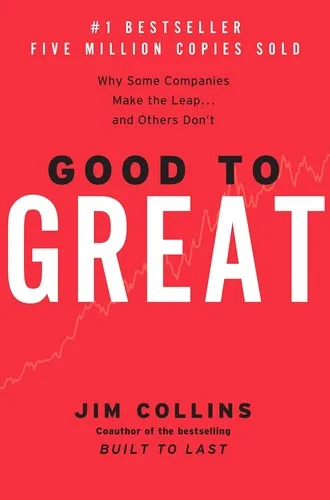
Good to Great asks a question every founder and manager cares about: why do some good companies become great, while others with the same chances stay merely good? Jim Collins and his research team spent five years on it, and the book came out in 2001.
The method was a comparison. The team screened companies that had appeared on the Fortune 500 and looked for a specific pattern: years of average stock performance, a transition point, and then a long run of returns well above the market. Only a handful of companies passed. Each was compared with a similar company in the same industry that didn't make the leap.
The book's framework came out of those comparisons. This summary covers the framework and the criticism it has attracted since, because both are useful.
The framework in one picture
Collins arranges his findings into three stages:
- Disciplined people: Level 5 leadership, and first who, then what.
- Disciplined thought: confront the brutal facts, and the Hedgehog Concept.
- Disciplined action: a culture of discipline, and technology as an accelerator.
Around all three turns the flywheel: the steady build-up of momentum that turns good into great.
Level 5 leadership
The leaders who took companies from good to great weren't the celebrity CEOs the team expected. They combined personal humility with intense professional will. They gave credit to others when things went well and took responsibility when they didn't, which Collins describes as looking out the window and into the mirror. And they were ambitious for the company, not for themselves.
Apply it: in your next team update, credit others for one win and own one miss yourself.
First who, then what
The great companies didn't start with a new strategy. They started by getting the right people on the bus, the wrong people off it and the right people in the right seats, and only then decided where to drive. With the right people, motivation and supervision take care of themselves. With the wrong ones, even the right direction fails.
Apply it: for each key role on your team, ask whether you'd hire that person again today. A hesitation is information.
Confront the brutal facts
Great companies faced reality, however uncomfortable. Collins draws on the Stockdale Paradox, named after James Stockdale, a US admiral held as a prisoner of war in Vietnam for years: keep unwavering faith that you'll prevail in the end, while confronting the most brutal facts of your current reality. The prisoners who struggled most, Stockdale observed, were the optimists who expected to be home by a certain date and kept being disappointed.
Apply it: write down the one fact about your business or career you'd rather not look at. Then write what you'll do about it.
Join the free list for new syntheses.
One book's 20%, with the prompts to apply it.
Free. No spam.
The Hedgehog Concept
The name comes from the fable of the fox, who knows many things, and the hedgehog, who knows one big thing. The great companies found one simple, clear concept at the overlap of three circles:
- What you're deeply passionate about.
- What you can be the best in the world at, and just as important, what you can't.
- What drives your economic engine, usually expressed as a single "profit per X" measure.
Collins stresses that it took the companies years to get clear on it, and that it's about understanding, not a goal or a slogan.
Apply it: draw the three circles for your own work. Fill each with honest answers, and look at what sits in the middle.
A culture of discipline
Once they had the concept, the great companies stuck to it. They built a culture of disciplined people taking disciplined action within a clear framework, and they were as willing to stop doing things that didn't fit as to start new ones. Collins suggests keeping a "stop doing" list alongside the to-do list.
Technology as an accelerator
The great companies didn't use technology to start their transformation. They used it to speed up momentum they already had, and only when it fitted their Hedgehog Concept. Chasing technology for its own sake was a trait of the comparison companies.
The flywheel and the doom loop
There was no single defining moment in any of the transformations. Instead, Collins describes a heavy flywheel: you push it, it turns slowly, you keep pushing in the same direction, and eventually momentum builds until it seems to move by itself. From outside it looks like a breakthrough. From inside it was years of consistent work.
The comparison companies fell into the doom loop: big programmes, dramatic launches, new leaders and reversals of direction, without ever building momentum.
The critique worth knowing
Good to Great has a well-known problem: several of its great companies later struggled badly. Circuit City went bankrupt, and Fannie Mae needed a government rescue during the 2008 financial crisis. Critics, notably Phil Rosenzweig in The Halo Effect, argue that studies like this pick winners first and then describe their traits in flattering terms, which makes the traits look more causal than they are.
The fair reading: the principles are sensible and still widely used, but they describe what the companies did during their good years, not a guaranteed formula. Collins himself later wrote How the Mighty Fall about how great companies decline.
Do this today
- Credit others for a win and own one miss yourself.
- Check the bus: would you rehire each key person today?
- Write the brutal fact you've been avoiding.
- Draw your three circles, and start a "stop doing" list.
3 prompts to go deeper
- "Here's what I do and what earns money: [describe it]. Help me fill in the three circles of the Hedgehog Concept honestly."
- "What's my 'profit per X'? Here's how my business works: [describe it]."
- "Here are my current projects: [list them]. Which ones fit my core concept, and which belong on a stop-doing list?"
FAQ
What is Good to Great about?
It's Jim Collins's study of why some good companies became great, sustained over many years, while similar companies didn't. It sets out a framework: Level 5 leadership, first who then what, confronting brutal facts, the Hedgehog Concept, a culture of discipline, technology accelerators and the flywheel.
What is the Hedgehog Concept in Good to Great?
A simple, clear understanding of the overlap between what you're deeply passionate about, what you can be the best in the world at, and what drives your economic engine. Collins argues the great companies found this overlap and then stuck to it.
Who wrote Good to Great?
Jim Collins, who also co-wrote Built to Last. Good to Great was published in 2001.
Is Good to Great still relevant?
Its leadership and focus principles are still widely used. Read it alongside its critics: several of its featured companies later declined, which suggests the framework describes good practice rather than guaranteeing results.
Run it, don't just read it
The Hedgehog Concept is a focus decision, and so is the Find Your 20% focus audit, which applies the same idea to your own week. For the beliefs that come before the strategy, read the Start With Why summary. For leading the people on the bus, see the Extreme Ownership summary, and for the long, unglamorous build-up behind the flywheel, the Atomic Habits summary.
Change is easier to face than to deny: the Who Moved My Cheese summary is the short version of that lesson.
The next synthesis, the week it drops.
Distilled, not summarized. Free.
Free. No spam.