
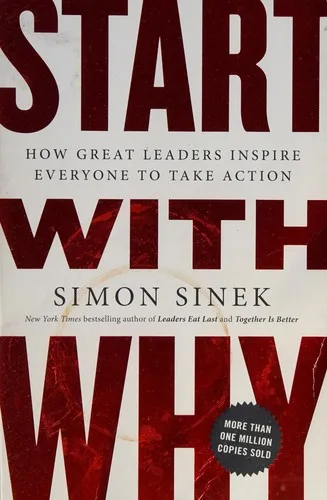
Start With Why grew out of a short talk with one diagram: three circles inside each other. Simon Sinek published the book in 2009, and its central line has since become a cliché in marketing meetings: people don't buy what you do, they buy why you do it.
Clichés become clichés because they're useful. Underneath the slogan is a practical tool for writing a pitch, hiring a team and saying no to the wrong opportunities. There are also a few claims worth questioning.
This Start With Why summary keeps the 20% you can use, and flags the rest.
The Golden Circle
Sinek's model has three rings:
- What (the outer ring): the products or services you sell. Every organisation knows this.
- How (the middle ring): what makes you different, your process or approach. Some organisations know this.
- Why (the centre): your purpose, cause or belief. Why the organisation exists beyond making money. Very few can say it clearly.
Most companies communicate from the outside in: here's what we make, here's how it's better, please buy it. Sinek argues that the organisations that inspire loyalty communicate from the inside out: here's what we believe, here's how we act on it, and, by the way, here's what we make.
Sinek's best-known illustration is Apple. A conventional pitch would go: we make great computers, they're well designed and easy to use, want to buy one? His rewrite of Apple's actual approach starts with the belief, in challenging the status quo and thinking differently, then explains that the way it does this is through well-designed, easy-to-use products, and only then mentions that it happens to make computers. Same facts, reversed order, very different pull.
Apply it: rewrite your homepage headline or your elevator pitch so the first sentence is a belief, not a product.
Manipulation versus inspiration
Sinek separates two ways to influence behaviour. Manipulation works: price cuts, promotions, fear, aspirational messaging, peer pressure and novelty all drive sales. But they buy transactions, not loyalty, and they need repeating, often at a rising cost.
Inspiration is what makes people choose you when a cheaper or more convenient option exists. It comes from shared belief. Customers who buy because of Why stay, defend you and tell others.
Apply it: list every reason a customer bought from you last month. Mark each one as manipulation (price, urgency, fear) or inspiration (belief, identity). If it's all the first, you're renting your customers.
Join the free list for new syntheses.
One book's 20%, with the prompts to apply it.
Free. No spam.
Why the Wright brothers won
Sinek's favourite story is the race to powered flight. Samuel Pierpont Langley had government funding, prestige and the best-connected team. The Wright brothers had none of that. Sinek's reading is that the Wrights and their small team were driven by a cause they believed in, while Langley was chasing the result and the recognition, and the people who believed did the extra work.
The same theme runs through his use of Martin Luther King Jr. The famous speech was a statement of belief, not a project plan, and people came because they shared the belief.
Clarity, discipline, consistency
The book's most practical section turns the circles into a management test:
- Clarity of Why. Leaders must be able to state the purpose plainly.
- Discipline of How. The values and principles that guide decisions, and the willingness to hold to them.
- Consistency of What. Everything you say and make should prove the Why.
When these line up, decisions get easier: an opportunity that doesn't fit the Why is a no, however profitable it looks.
Apply it: write your Why in one sentence. Then check your last three big decisions against it. Did they prove it or contradict it?
Sinek's shorthand for this is the celery test. If you go to a dinner party and everyone gives you advice about what you should buy, you'll come home with a trolley full of things. If you know your Why (say, health), you only buy what proves it: the celery, not the cookies. And anyone who sees what's in your trolley knows what you stand for.
When the Why goes fuzzy
Sinek also describes what happens as organisations grow. Early on the founder's belief is obvious, because the founder is in every room. As the company scales, the Why gets diluted until people only talk about What: revenue, market share, products. His example is Walmart after Sam Walton's death, which he argues drifted from serving people towards pure cost-cutting.
Apply it: write down, in one paragraph, why you started what you're running now. Read it before your next strategy meeting.
Start with the believers
Sinek borrows the diffusion of innovations model: new ideas spread from innovators to early adopters before the mainstream follows. His advice is to aim your message at the people who already share your belief, rather than chasing the sceptical middle. They carry the idea to everyone else.
Where the book overreaches
Three honest caveats. Sinek links the Golden Circle to parts of the brain; treat that as a metaphor rather than settled neuroscience. The examples are chosen with hindsight, so companies that had a strong Why and still failed don't appear. And a Why can't rescue a weak product. It amplifies a good What; it doesn't replace it. Used as a communication and decision tool rather than a law of business, it's very good.
Do this today
- Write your Why in one sentence, then cut it until a stranger would understand it.
- Rewrite one pitch inside out: belief first, product last.
- Sort last month's sales into manipulation and inspiration.
- Check one upcoming decision against your Why before you say yes.
3 prompts to go deeper
- "Here's what my business does: [describe it]. Help me find the Why underneath it and state it in one sentence."
- "Rewrite this pitch so it starts with Why: [paste it]."
- "Which of my current projects contradict the purpose I say I have?"
FAQ
What is the main idea of Start With Why?
Organisations and leaders that inspire loyalty communicate their purpose first, then how they act on it, then what they offer. People respond to belief, and a clear Why makes decisions and messaging consistent.
What is the Golden Circle?
Simon Sinek's model of three nested circles: Why at the centre, How in the middle and What on the outside. He argues that inspiring organisations communicate from the centre outwards.
Is Start With Why worth reading?
Yes, especially if you write pitches, lead a team or build a brand. The core idea fits in one talk, so the book's value is in the examples and the clarity, discipline and consistency test.
Who wrote Start With Why?
Simon Sinek. It was first published in 2009.
Run it, don't just read it
A summary tells you what the book says. The value comes from rewriting one real pitch or decision with it. Covey's version of the same idea is "begin with the end in mind" in the 7 Habits of Highly Effective People summary. For the other half of persuasion, framing what you want around what others want, read the How to Win Friends and Influence People summary. Then pick your priorities with the Find Your 20% focus audit, or try the free Atomic Habits Action Vault.
It's on our lists of the best books for entrepreneurs, best books for content creators, best books for consultants and best books for managers. For what turns a clear Why into a lasting company, read the Good to Great summary.
The next synthesis, the week it drops.
Distilled, not summarized. Free.
Free. No spam.