
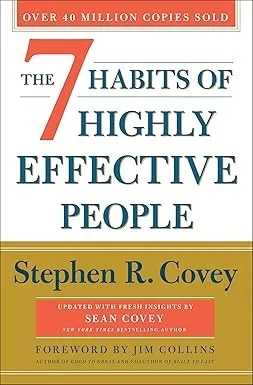
The 7 Habits of Highly Effective People is the book most people think they've already read. They know the titles. Be proactive. Begin with the end in mind. Few could tell you why the habits come in that order, and that's the part that matters.
Stephen R. Covey published the book in 1989, and his argument was that most success advice teaches technique: tricks, tactics, quick fixes. He wanted to go back to character, the principles underneath behaviour. The habits are a sequence, not a menu.
This 7 Habits of Highly Effective People summary keeps the 20% that changes how you spend next week.
The idea underneath: inside-out
Covey's core idea is a paradigm shift: the way you see a problem decides how you can solve it. Change the lens and the behaviour follows.
Most personal-development advice works outside-in: fix the situation, the schedule or the other person, and you'll be fine. Covey argues the reverse. Lasting change starts with your own principles and character, then works outward to your results and relationships. A time-management trick bolted onto a life with no clear priorities just helps you do the wrong things faster.
He maps growth as a maturity continuum:
- Dependence: "you" take care of me, and "you" are to blame.
- Independence: "I" can do it, and "I" am responsible.
- Interdependence: "we" can do something better together.
Habits 1 to 3 move you from dependence to independence. Covey calls this the private victory. Habits 4 to 6 build interdependence, the public victory. Habit 7 renews everything. You can't skip ahead: people who try to win with others before they've won with themselves end up relying on technique.
Habit 1: Be proactive
Between what happens to you and how you respond, there's a gap. Proactive people use it. Reactive people let circumstances, moods and other people fill it for them.
Covey's most practical tool is two circles. Your circle of concern holds everything you worry about: the economy, your boss's mood, the news. Your circle of influence holds what you can actually affect. Reactive people spend their energy on the first, and their influence shrinks. Proactive people work on the second, and it grows.
Apply it: list what's worrying you this week. Cross out everything you can't influence. Pick one thing left and act on it today.
Habit 2: Begin with the end in mind
Everything is created twice: first in the mind, then in reality. If you don't design your own life, someone else's plan will design it for you.
Covey's exercise is famous for a reason: imagine your own funeral and what you'd want the people closest to you to say. The gap between that and how you spend your days is your real to-do list. He suggests turning the answer into a personal mission statement, a short set of principles you can test decisions against.
Apply it: before your next big project, write one sentence describing what "done well" looks like. Then check every decision on the project against that sentence. It's the same discipline at the scale of a week.
Habit 3: Put first things first
This is the habit with the biggest payoff, and Covey's time management matrix is the tool:
- Quadrant I: urgent and important. Crises, deadlines.
- Quadrant II: important, not urgent. Planning, relationships, health, skill-building, prevention.
- Quadrant III: urgent, not important. Most interruptions, many meetings.
- Quadrant IV: neither. Busywork and distraction.
Effective people live in Quadrant II. Time spent there shrinks Quadrant I, because most crises are Quadrant II work that was skipped. The trick is to schedule your priorities rather than prioritise your schedule: plan the week, not the day, and protect the important blocks first.
Apply it: block two hours this week for one Quadrant II task, and treat it like a client meeting. The Find Your 20% focus audit helps you pick which one.
Join the free list for new syntheses.
One book's 20%, with the prompts to apply it.
Free. No spam.
Habits 4 to 6: the public victory
Covey's metaphor for trust is the emotional bank account. Keeping promises, small courtesies and honesty are deposits. Broken commitments and disrespect are withdrawals. Every relationship runs on the balance.
- Habit 4: Think win-win. Look for agreements that benefit both sides, and be willing to walk away when there isn't one. A deal where one side loses tends to come back as a problem.
- Habit 5: Seek first to understand, then to be understood. Most people listen with the intent to reply. Empathic listening means listening until you can state the other person's view to their satisfaction. Only then make your case. It's the single most useful habit in sales, management and family life.
- Habit 6: Synergize. When people with different strengths genuinely understand each other, the result can beat either person's original idea.
If this section resonates, the How to Win Friends and Influence People summary is its practical companion.
Habit 7: Sharpen the saw
The last habit protects the person doing all of the above. Covey describes renewal in four dimensions: physical (exercise, rest, nutrition), mental (reading, learning, planning), social and emotional (relationships) and spiritual (values, reflection, meaning). All of it is Quadrant II. Skipping it feels efficient until the saw goes blunt.
Apply it: pick one dimension you've neglected this month and put a single renewal block for it in next week's plan, before the urgent work arrives.
Deep, deliberate practice is part of mental renewal. The 10,000-hour calculator shows how long mastery takes at your pace, and the Deep Work summary covers how to protect the time.
Do this today
- Circle-of-influence audit: cross out every worry you can't affect, and act on one you can.
- Draft three lines of a personal mission statement.
- Plan next week in Quadrant II first. Block the important work before anything else.
- In your next disagreement, summarise their view until they agree you've got it, before you reply.
- Book one renewal block for exercise, reading or a relationship.
3 prompts to go deeper
- "Here's my week: [list it]. Sort each item into Covey's four quadrants and tell me what to cut."
- "Help me draft a personal mission statement from these values: [list them]."
- "Here's a conflict I'm in: [describe it]. Help me state the other person's view so well they'd agree with it."
FAQ
What are the 7 habits of highly effective people?
- Be proactive. 2. Begin with the end in mind. 3. Put first things first. 4. Think win-win. 5. Seek first to understand, then to be understood. 6. Synergize. 7. Sharpen the saw.
What is the main idea of the 7 Habits?
Effectiveness comes from character and principles, not techniques. You win with yourself first (habits 1 to 3), then with others (habits 4 to 6), and keep renewing (habit 7).
Which of the 7 habits matters most?
Our pick is Habit 3, put first things first. Living in Quadrant II is the habit that makes the others possible, because it's where planning, relationships and renewal actually get time.
Who wrote The 7 Habits of Highly Effective People?
Stephen R. Covey. It was first published in 1989.
Run it, don't just read it
A summary tells you what the book says. The value comes from running one habit until it's automatic. For the method of turning a book into a system, see the free Atomic Habits Action Vault, and try the free tools.
It's on our lists of the best books for consultants, best books for managers and best books for personal growth. For the leadership side of being proactive, owning everything in your world, read the Extreme Ownership summary.
The next synthesis, the week it drops.
Distilled, not summarized. Free.
Free. No spam.