
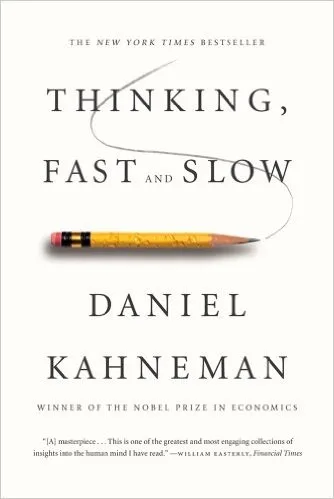
Thinking, Fast and Slow is the book everyone cites and few finish. Daniel Kahneman, the psychologist who won the Nobel Prize in economics in 2002, published it in 2011 as a tour of decades of research on how people actually judge and decide. It's long, dense and full of experiments.
Most of it rests on one idea. Your mind has two ways of thinking, and the fast one is in charge far more often than you believe. Once you see that, you can design around it.
This Thinking, Fast and Slow summary keeps the 20% that changes how you make decisions.
System 1 and System 2
Kahneman describes two modes of thought, which he calls characters in a story rather than parts of the brain:
- System 1 is fast, automatic and effortless. It reads faces, finishes sentences and gives you a gut answer before you've asked for one.
- System 2 is slow, deliberate and effortful. It does the long division, checks the logic and follows the rules.
The twist is that System 2 is lazy. It accepts System 1's suggestions most of the time without checking. Kahneman's famous example: a bat and a ball cost $1.10 together, and the bat costs $1 more than the ball. How much is the ball? The answer that leaps out is 10 cents. It's wrong: the ball is 5 cents. Most of the time we just don't check.
Apply it: before any decision that matters, ask "what would I have to believe for my first answer to be wrong?" That one question wakes System 2 up.
The easier question
Kahneman's most useful idea may be substitution. Faced with a hard question, System 1 answers an easier one and hands it over as if it were the original. "Will this investment pay off?" becomes "Do I like this company?" "Is this candidate good at the job?" becomes "Did I enjoy the interview?"
It works with a second habit he calls WYSIATI: what you see is all there is. System 1 builds the most coherent story it can from whatever information is in front of it, and it doesn't flag what's missing. Confidence comes from how well the story hangs together, not from how much you actually know.
Apply it: write down the real question in one sentence before you answer it, then list what you'd want to know but don't.
The biases worth knowing
The book catalogues dozens. A handful do most of the damage in work and life:
- Anchoring. The first number you hear pulls your estimate towards it, even when it's irrelevant. Whoever names a price first in a negotiation shapes the outcome.
- Availability. You judge how likely something is by how easily examples come to mind. Vivid, recent stories feel more common than they are.
- Base-rate neglect. A compelling description beats the statistics. You judge a startup on its pitch instead of on how often startups like it succeed.
- The planning fallacy. Plans assume the best case. Projects run over because we picture our plan, not the record of similar projects.
- Regression to the mean. Extreme results tend to be followed by more ordinary ones. A great quarter after a bad one isn't always proof your fix worked.
- Overconfidence. Experts and amateurs alike feel more certain than their track record justifies. A coherent story produces confidence, not accuracy.
The fix Kahneman favours for planning is the outside view: instead of reasoning up from the details of your plan, start from how similar projects actually turned out, then adjust.
Join the free list for new syntheses.
One book's 20%, with the prompts to apply it.
Free. No spam.
Loss aversion and prospect theory
The work that earned Kahneman his Nobel, developed with Amos Tversky, is prospect theory. Two findings matter most.
First, people judge outcomes as gains and losses from a reference point, not as final states. A pay rise feels like a loss if a colleague got more.
Second, losses loom larger than gains. Losing a sum hurts more than winning the same sum feels good. That's why people hold losing investments too long, protect what they already own and turn down good bets that carry a small chance of loss.
It also explains framing. The same option described as "90% survival" or "10% mortality" gets chosen differently, even though the facts are identical.
Apply it: reframe a decision both ways, as a gain and as a loss. If your answer flips, the frame was deciding for you.
Two selves: experiencing and remembering
Kahneman separates the experiencing self, which lives through each moment, from the remembering self, which keeps score afterwards. They disagree. Memory follows the peak-end rule: we judge an experience mostly by its most intense moment and how it ended, and we largely ignore how long it lasted.
Apply it: for anything you design (a client project, a launch, a holiday), protect the ending. A strong finish changes how the whole thing is remembered.
What hasn't held up
Read the book with one caution. Some of the social priming research it describes, in which subtle cues are said to change behaviour, has failed to replicate, and Kahneman publicly acknowledged leaning too hard on it. The core of the book, on heuristics, biases and prospect theory, rests on much broader evidence.
Do this today
- Name the real question in one sentence before you decide anything important.
- Look up the base rate. How often do projects, hires or ventures like this one work out?
- Run a pre-mortem. Imagine it's a year from now and the plan failed. Write down why.
- Reframe once. State the choice as a gain, then as a loss, and see if your answer moves.
- Name your own anchor before your next negotiation, so theirs doesn't set the range.
3 prompts to go deeper
- "Here's a decision I'm about to make: [describe it]. What easier question might I be answering instead?"
- "Run a pre-mortem on this plan: [describe it]. Give me the five most likely reasons it fails."
- "What's the base rate for this kind of outcome: [describe it]? How does my plan compare?"
FAQ
What is the main idea of Thinking, Fast and Slow?
Human judgement runs on two systems: a fast, intuitive one that does most of the work and a slow, deliberate one that rarely checks it. Many predictable errors in judgement come from the fast system's shortcuts.
What are System 1 and System 2?
System 1 is automatic and effortless: intuition, first impressions, gut answers. System 2 is slow and effortful: calculation, logic and self-control. Kahneman uses them as a shorthand, not as literal regions of the brain.
What is the bat and ball problem?
A bat and a ball cost $1.10 together, and the bat costs $1 more than the ball. The intuitive answer for the ball is 10 cents; the correct answer is 5 cents. It shows how readily System 2 accepts System 1's first answer.
Who wrote Thinking, Fast and Slow?
Daniel Kahneman. It was first published in 2011.
Run it, don't just read it
A summary tells you what the book says. The value comes from building one check into one decision at a time. For how behaviour drives money decisions, read The Psychology of Money summary. For how influence plays on the same shortcuts, see the How to Win Friends and Influence People summary. For the method of turning a book into a system, see the free Atomic Habits Action Vault and the free tools.
It's on our lists of the best books for entrepreneurs, best books for consultants and best books for personal growth. To use these biases at the negotiating table, read the Never Split the Difference summary.
The next synthesis, the week it drops.
Distilled, not summarized. Free.
Free. No spam.