
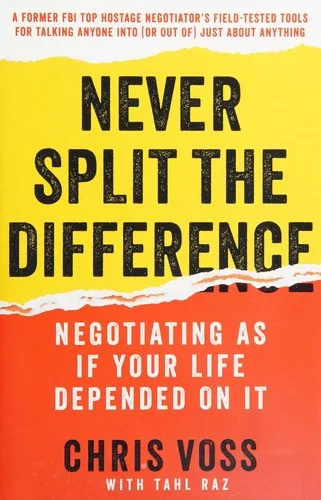
Never Split the Difference is a negotiation book by Chris Voss, a former FBI hostage negotiator who became the bureau's lead international kidnapping negotiator. He wrote it with journalist Tahl Raz and published it in 2016.
Its argument is that most negotiation advice assumes people are rational, and they aren't. Hostage negotiation taught Voss that deals are won by understanding emotions, slowing the conversation down and getting the other side to feel heard. The same techniques work on salaries, contracts, clients and landlords.
This summary covers the toolkit, in the order you'd use it.
The core idea: tactical empathy
Voss's foundation is tactical empathy: understanding the other side's feelings and perspective, and saying it out loud. It isn't agreeing with them, and it isn't being nice. It's showing them you understand their position, because people who feel understood relax, talk more and give away information.
Behind it is a simple view of people: we make decisions emotionally and justify them rationally afterwards. If you only argue facts, you're negotiating with the wrong part of the brain.
Mirroring
The simplest technique: repeat the last one to three words the other person said, as a question. "We can't do that this quarter." "This quarter?"
It sounds too simple to work, but it prompts people to explain and expand, and it builds rapport because people like those who sound like them. Voss pairs it with a calm, slow voice he likens to a late-night FM radio DJ, which signals control and lowers the temperature.
Apply it: in your next tense conversation, mirror once and then stay silent. Let them fill the gap.
Labelling
A label names the emotion you think the other person feels: "It seems like you're worried about the timeline." "It sounds like this has been frustrating." Start with "It seems", "It sounds" or "It looks", not "I", so it reads as an observation rather than a claim about you.
Labelling negative emotions defuses them, and labelling positive ones reinforces them. Voss's related move is the accusation audit: list the worst things the other side might think about you, and say them first. "You're probably going to think this offer is unfair." Naming the fear takes the sting out of it.
Apply it: before a hard conversation, write down three negative things they might think about you, and open with them.
Join the free list for new syntheses.
One book's 20%, with the prompts to apply it.
Free. No spam.
Aim for "no", then "that's right"
Most salespeople chase a "yes". Voss argues that pushing for yes makes people defensive, and that "no" makes them feel safe and in control. So he asks questions designed to be answered no: "Is now a bad time to talk?" "Have you given up on this project?" Saying no lets people protect themselves, and it often restarts a stalled conversation.
The breakthrough moment he wants isn't "you're right", which people say to end a conversation. It's "that's right", which they say when your summary of their position is so accurate they feel truly understood. Get there by summarising their view back to them, in their terms.
Calibrated questions
Instead of saying no to an unreasonable demand, ask an open question that starts with "how" or "what". "How am I supposed to do that?" "What's the biggest challenge you face here?" "How would you like me to proceed?"
These questions give the other side the illusion of control while pushing them to solve your problem. They also avoid "why", which tends to sound like an accusation.
Apply it: next time someone makes a demand you can't meet, reply with "How am I supposed to do that?" in a calm voice, and wait.
Bargaining: the Ackerman model
For the price itself, Voss teaches a planned sequence. Set your target, then open at 65% of it, and move to 85%, 95% and finally 100%, making each increase smaller. Use a precise, non-round number for the final offer, because it sounds calculated, and throw in a non-monetary item at the end to show you've reached your limit.
He also warns about deadlines, which are often more flexible than they look, and about loss aversion: people work harder to avoid losing something than to gain the same thing, so frame what they stand to lose.
Black swans
Voss uses "black swans" for the unknown pieces of information that change everything in a negotiation: a hidden constraint, a private worry, a deadline you weren't told about. Every negotiation has a few. Your job is to listen hard enough to find them, which is what all the techniques above are for.
Why never split the difference
Compromise feels fair, but Voss's image for it is wearing one black shoe and one brown shoe because you couldn't agree on which colour. Meeting in the middle often leaves both sides with a bad outcome. Better to understand the other side well enough to find the deal that actually works.
Do this today
- Mirror once in your next conversation, then stay silent.
- Write an accusation audit before your next hard talk.
- Ask a "no"-oriented question to restart a stalled thread.
- Answer one demand with "How am I supposed to do that?"
3 prompts to go deeper
- "I'm about to negotiate [situation]. Write me an accusation audit: the worst things the other side might think about me."
- "Here's what the other side said: [paste it]. Give me three labels and two calibrated questions I could use in reply."
- "My target price is [number]. Build me an Ackerman bargaining plan with a precise final number and a non-monetary extra."
FAQ
What is Never Split the Difference about?
It's a negotiation book by former FBI hostage negotiator Chris Voss. It argues that negotiation is driven by emotion, and teaches techniques like tactical empathy, mirroring, labelling and calibrated questions to understand the other side and reach better deals than compromise.
What does "never split the difference" mean?
That meeting in the middle is often a bad deal for both sides. Voss argues you should understand the other party well enough to find a better outcome than a compromise neither side wanted.
Who wrote Never Split the Difference?
Chris Voss, with Tahl Raz. It was first published in 2016.
Is Never Split the Difference a good book?
It's one of the most practical negotiation books available, because the techniques are specific and you can try them the same day. It's most useful for salary talks, sales, contracts and any conversation where emotions run high.
Run it, don't just read it
Pick one technique and use it in one real conversation this week. For the other side of persuasion, making people want to say yes, read the How to Win Friends and Influence People summary. For why people decide emotionally first, see the Thinking, Fast and Slow summary, and for power dynamics to watch out for, the 48 Laws of Power summary.
The next synthesis, the week it drops.
Distilled, not summarized. Free.
Free. No spam.