
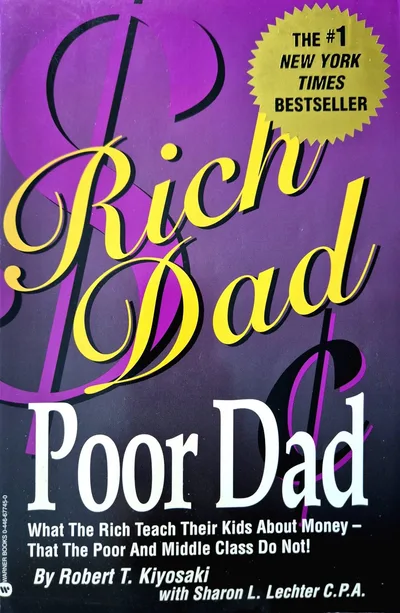
Rich Dad Poor Dad is the money book people read first and argue about forever. Robert Kiyosaki first published it in 1997, framed around two father figures: his own father, highly educated and always short of money, and his best friend's father, who left school early and built wealth.
Read it as a spreadsheet and you'll find plenty to dispute. Read it as a parable and it does something most finance books never manage: it changes how you see money in the first ten pages.
This Rich Dad Poor Dad summary keeps the 20% that holds up, the key lessons worth acting on, and flags the parts to ignore.
Two dads, two money scripts
The whole book hangs on one contrast. When something was out of reach, poor dad said "I can't afford it." Rich dad asked "How can I afford it?"
One sentence ends the thinking. The other starts it. Kiyosaki's argument is that the poor and the middle class aren't held back mainly by income. They're held back by the scripts they inherited about money: work hard, get a safe job, buy a house, save. Those scripts were written for a world of pensions and job security.
Apply it: for one week, catch every "I can't afford it" you say or think, and rewrite it as a question.
Lesson 1: The rich don't work for money
Kiyosaki describes the rat race: earn more, spend more, owe more, repeat. Fear (of not paying the bills) and desire (for the next upgrade) keep people working for a salary that's spent before it arrives.
The way out isn't a bigger salary. It's making money work for you, so income arrives whether or not you clock in.
Apply it: look at your last three pay rises. Where did the extra money go? If most of it went on bigger monthly costs, you've seen the rat race from the inside. Decide now what share of the next rise goes to building assets.
Assets vs liabilities: the idea that holds up
This is the 20% of the book worth the whole price. Kiyosaki's definitions are deliberately simple:
- An asset puts money in your pocket. Rental property with positive cash flow, a business, dividend-paying shares, royalties.
- A liability takes money out of your pocket. Car loans, consumer debt, and, by his definition, the home you live in.
He then draws three cash-flow patterns. The poor earn a salary and spend it on expenses. The middle class earn a salary and buy liabilities they think are assets, such as a bigger house or a newer car, so their outgoings rise with their income. The rich buy assets, and the assets pay the expenses.
The "your house is not an asset" line is the most debated in the book. It's a definition, not a law. A home can still be a sound decision. Kiyosaki's point is narrower: something that costs you money every month isn't feeding your asset column, whatever it's worth on paper.
Apply it: list everything you own and owe. Next to each item, write whether it puts money in or takes money out each month. Most people find their "assets" column is shorter than they thought.
Join the free list for new syntheses.
One book's 20%, with the prompts to apply it.
Free. No spam.
Mind your own business
Lesson three separates your profession from your business. Your profession is how you earn. Your business is the asset column you're building.
Kiyosaki doesn't tell you to quit your job. He tells you to keep it and buy or build assets on the side, then let those assets fund the things you want, instead of buying the luxuries first.
Taxes, corporations and financial IQ
Lessons four and five argue that the rich play by rules most employees never learn: how corporations and tax law treat income differently, and how financial intelligence (accounting, investing, understanding markets and the law) turns into opportunities others miss.
Take the principle, not the specifics. The tax examples are American and decades old. Learn how the rules work where you live, and pay for good advice before you act on anything clever.
The durable part is the idea of financial IQ itself: money rewards people who understand how it moves. Reading a balance sheet, knowing what a deal really costs, and spotting when an "opportunity" is someone else's exit are learnable skills, and they're worth more than any single tip in the book.
Work to learn, don't work for money
The final lesson may be the most durable. Choose jobs for what they teach you, not only what they pay. Kiyosaki singles out the skills that compound: selling and communication, managing people, managing cash flow. His point is that a talented specialist who can't sell or manage money is often just one skill short of real wealth.
Apply it: look at your current role and name the one transferable skill it's teaching you. If the answer is "none", that's the real cost of the job.
What to ignore
Two cautions keep this book useful instead of dangerous. First, the dialogue is a teaching device, not a case study. Treat the stories as illustrations, not evidence. Second, the book is long on mindset and short on method. Borrowing heavily to buy assets carries real risk, and none of this is personal financial advice. Pair it with The Psychology of Money, which is far better on behaviour and risk.
Do this today
- Rewrite one "I can't afford it" as "How could I afford it?"
- Sort your balance sheet by cash flow: money in or money out each month.
- Name one asset you could start building with a small amount of time or money each month.
- Pick one compounding skill (selling, managing people or managing money) and spend 20 minutes on it this week.
3 prompts to go deeper
- "Here's what I own and owe: [list it]. Using Robert Kiyosaki's definitions, which are assets and which are liabilities?"
- "What's the smallest asset I could start building alongside my job in the next 90 days?"
- "Which of my money beliefs did I inherit, and which would I choose today?"
FAQ
What is Rich Dad Poor Dad about?
It's a personal-finance book built on a contrast between two father figures with opposite views of money. Its core lessons are to make money work for you, know the difference between assets and liabilities, build your own asset column, and work to learn rather than only to earn.
What are the six lessons of Rich Dad Poor Dad?
The rich don't work for money. Why teach financial literacy. Mind your own business. The history of taxes and the power of corporations. The rich invent money. Work to learn, don't work for money.
Is Rich Dad Poor Dad worth reading?
Yes, as a mindset shift, especially as a first money book. The asset-versus-liability idea alone changes how most readers spend. It's weaker as a practical guide, so pair it with a book on behaviour and risk.
Who wrote Rich Dad Poor Dad?
Robert Kiyosaki, with Sharon Lechter. It was first published in 1997.
Run it, don't just read it
A summary tells you what the book says. The value comes from changing one habit at a time. For the method of turning a book into a system, see the free Atomic Habits Action Vault or the free tools. For a sharper take on what actually builds wealth, read the Almanack of Naval Ravikant summary.
This is a book summary, not financial advice.
It's on our list of the best books for entrepreneurs. For the oldest version of pay yourself first, read The Richest Man in Babylon summary.
The next synthesis, the week it drops.
Distilled, not summarized. Free.
Free. No spam.