
Carol Dweck's Mindset has been quoted, misquoted, turned into posters, and weaponized by educators who don't understand what it actually says. Strip away the noise and the book makes two research-backed claims that hold up: how you think about your own ability changes what you achieve, and the praise people give you shapes how you handle failure.
Here's what the research actually found, what the "not yet" reframe means in practice, and where growth mindset gets misused as a slogan instead of a system.
Fixed vs Growth Mindset: The Core Distinction
Dweck's central finding: people hold one of two beliefs about intelligence and talent.
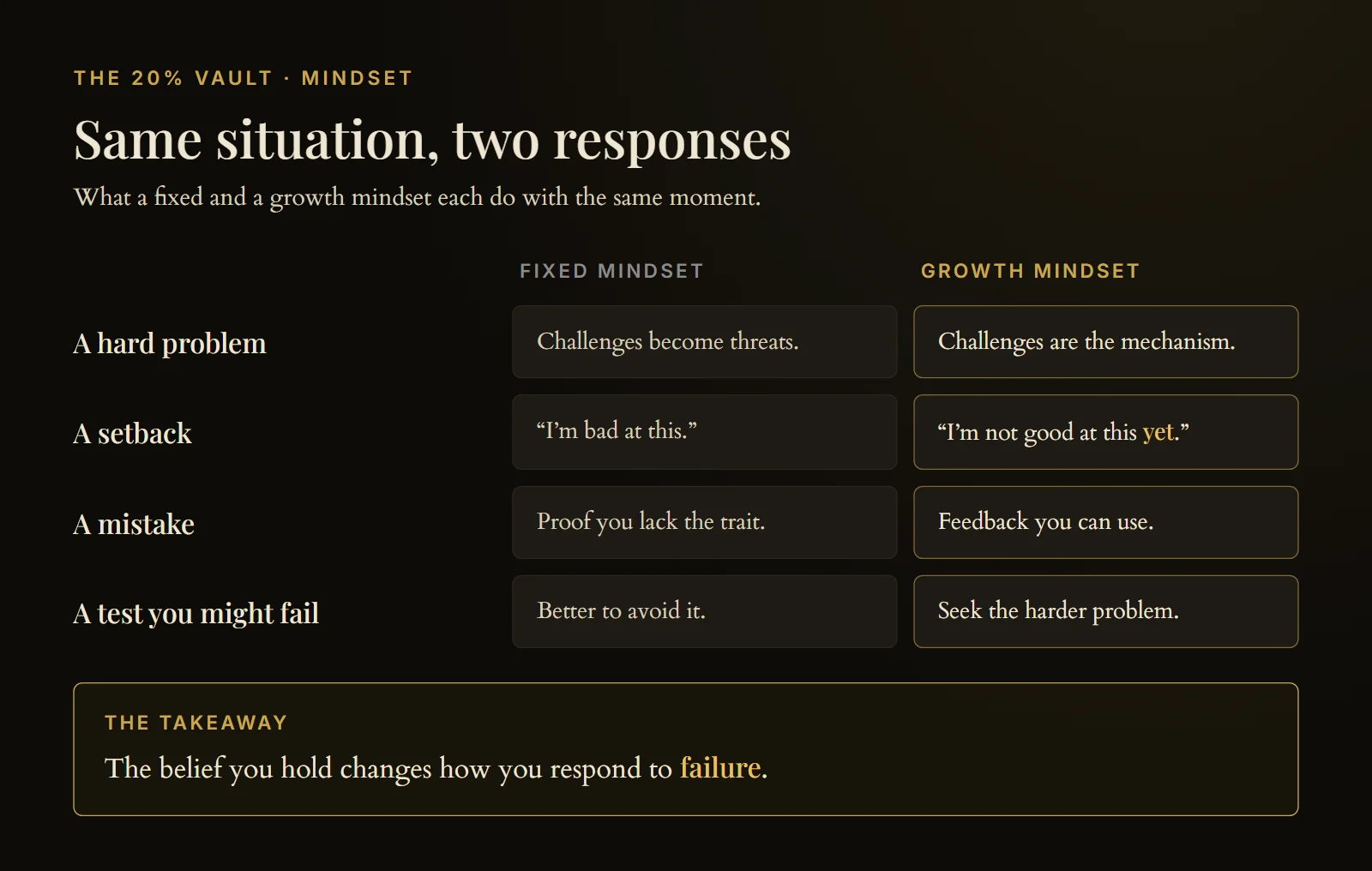
Fixed mindset believes intelligence is static — you're born with a set amount, and effort can't change it. Challenges become threats. If you struggle, it means you lack the trait. Better to avoid the test than prove you don't have it.
Growth mindset believes abilities develop through effort, strategy, and learning from failure. Challenges are the mechanism. Struggle means you're learning, not that you're incapable.
The belief you hold changes how you respond to mistakes. In one study, researchers measured electrical activity in participants' brains while they made errors on a simple task. Participants with a growth mindset showed a stronger error-awareness signal (the error positivity, or Pe), which the authors linked to paying closer attention to mistakes. They also answered more accurately right after a mistake. Pe strength accounted for that link.
It's not about positive thinking. It's about whether you believe the work you do changes what you're capable of. Fixed mindset says no. Growth mindset says yes, and then acts on it.
The Praise Research That Actually Matters
Dweck's 1998 study with psychologist Claudia Mueller ran six studies with 412 fifth graders in total. They gave kids a set of problems, then praised them in one of two ways:
- Intelligence praise: "You must be smart at these problems."
- Effort praise: "You must have worked hard at these problems."
Then they gave the kids harder problems and watched what happened.
Kids praised for intelligence:
- Chose performance goals (looking smart) over learning goals: 67% vs 8% for effort-praised kids
- Performed worse after failure and showed less task enjoyment
- Misreported their scores more often: 38% vs 13% for effort-praised kids, when reporting to an anonymous child at another school
- Described intelligence as a fixed trait
Kids praised for effort:
- Chose learning goals: 92% in the first study
- Held up better after failure than intelligence-praised kids
- Enjoyed the tasks more after failure
- Misreported scores at about the control rate (13% vs 14%)
- Described intelligence as something that can be improved
The finding is the core of the study: praise for the trait made kids more fragile after setbacks, and praise for the effort helped them hold up.
Person praise — even when positive — sends a message of contingent worth. "You're so smart" means your value depends on staying smart, so you avoid anything that might prove you're not. Process praise — "you tried a new strategy" or "you stuck with it" — means your value comes from the work, and the work is under your control.
This maps directly to identity-based habits from Atomic Habits: the language you use ("I'm a runner" vs "I run") shapes whether you see the behavior as something you are or something you do. Growth mindset is the same move at the cognitive level — intelligence isn't who you are, it's what you develop.
The "Not Yet" Reframe
Dweck tells the story of a Chicago high school that replaced failing grades with "Not Yet."
A student who didn't pass a course didn't get an F. They got "Not Yet."
The shift: an F is an identity judgment. "Not Yet" is a trajectory statement. It's a point on a learning curve. It gives you a path into the future instead of defining you by where you are now.
In her TED talk, Dweck contrasts the power of yet with the tyranny of now. Fixed-mindset students are gripped by now: if they can't do it immediately, they conclude they never will. Growth-mindset students treat not being able to do something yet as the starting point, not the verdict.
The "not yet" frame works because it makes visible what fixed mindset hides: current performance is not permanent capacity. A failing grade feels permanent. "Not yet" sounds temporary, because it is.
In practice, this shows up in how you talk to yourself after a setback. Fixed mindset: "I'm bad at this." Growth mindset: "I'm not good at this yet." One word, but it reopens the door effort can walk through.
Where Growth Mindset Gets Misused
Growth mindset has become a slogan in many classrooms and workplaces instead of a practice. Two failure modes keep showing up:
1. Calling Personal Qualities "Growth Mindset"
False growth mindset: labeling traits you already have — like being open to feedback or adaptable — as "having a growth mindset."
Real growth mindset isn't about what you are. It's about believing abilities can be developed, then doing the work to develop them. If you stop at the belief, you're running fixed mindset with better branding.
Picture a teacher who says "I have a growth mindset because I'm open to new ideas" but never changes a lesson after students struggle with it. The openness is real, but it's a trait, not a practice. Growth mindset is praising the process and engaging in it.
2. Growth Mindset as Empty Praise
A common version turns growth mindset into "everyone gets praised for effort," even when the effort is low or misdirected.
Process praise works when it's specific and tied to improvement. "You worked hard" as a blanket statement is noise. "You tried a new approach on that problem and it got you closer to the answer" is signal.
Growth mindset isn't "effort solves everything." It's "the right effort, applied to the right strategy, builds the skill." If a student keeps trying the same failing approach, praising effort alone doesn't help. You praise the search for better strategies.
The misuse strips growth mindset of its mechanism. Real growth mindset pairs the belief (abilities develop) with the action (deliberate practice toward improvement). Skip either half and you're left with motivational theater.
What Growth Mindset Actually Is
Strip it back to what the research supports:
Growth mindset is the belief that abilities develop through effort and strategy, which changes how you respond to difficulty.
- You see challenges as the mechanism, not the threat.
- You interpret failure as feedback, not as proof you lack the trait.
- You engage with mistakes instead of avoiding them.
- You seek harder problems because that's where the learning is.
It's not about feeling good. It's about staying engaged when the work gets hard, because you believe the work changes what you're capable of.
Dweck's studies show this belief is learnable. In a 2007 study of 7th graders, students taught that intelligence can grow (48 in the intervention, 43 in the control group) saw their grade decline reversed. The control group kept sliding. The lesson was that intelligence is something you develop, not something you have or don't.
Growth mindset works when it's grounded in a mechanism you can act on: the work you put in is what builds the capacity you have later. The rest is noise.
Related reading: the Atomic Habits summary and the Psychology of Money key takeaways.
The next synthesis, the week it drops.
Distilled, not summarized. Free.
Free. No spam.