
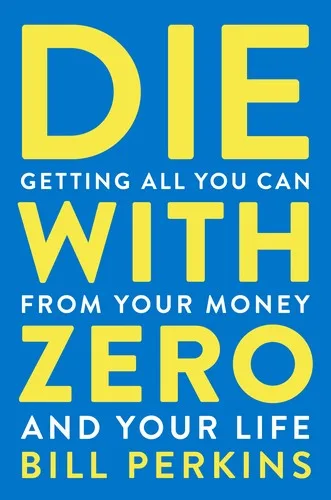
Bill Perkins's Die With Zero argues for optimizing for experiences, not account balances. The reviews I read describe the warning this way: saving for a far-off retirement can leave you with unspent money and a life full of experiences you can no longer enjoy fully.
The insight is not new, but Perkins frames it as an optimization problem. Your goal is not to maximize wealth. It is to maximize the overlap of health, money, and time. Here is the 20% of Die With Zero that changes how you think about money.
The Core Argument: Money Is Stored Energy for Experiences
Perkins starts with a simple observation: most people over-save. They defer experiences, hoard cash, and retire with more money than they will ever spend. The result is a life plan that ends with unspent money and a list of things never done.
The reviews put the book's core in one line. Physician on FIRE paraphrases the idea as: your life energy equals money, meaning the more energy you exert, the more money you accumulate. That is the review's wording, not a quotation from the book. The point is not to spend recklessly. It is to spend deliberately, while the experiences still fit the years you have.
Two ideas carry most of the argument:
- The experience curve. Each experience has a window when it is possible or most enjoyable. Money Hacking Mama calls it a "use it or lose it" window for every experience. Delaying trades those moments for a bigger balance.
- Memory dividends. A meaningful experience keeps paying out: stories, photos, shared moments with the people you were with. Physician on FIRE calls these "priceless memory dividends". The earlier you have the experience, the more years it has to pay out.
Illustrative example (my construction, not from the book): Take a 35-year-old who plans a big trip "after the next promotion" and keeps saving instead. At 50 the balance is bigger, but the knee and the energy for the trek may not be. The version taken at 35 gives more years of memories and more of the physical experience. The example is a way to test the argument, not a case the book makes.
The Three Resources: Health, Money, and Time
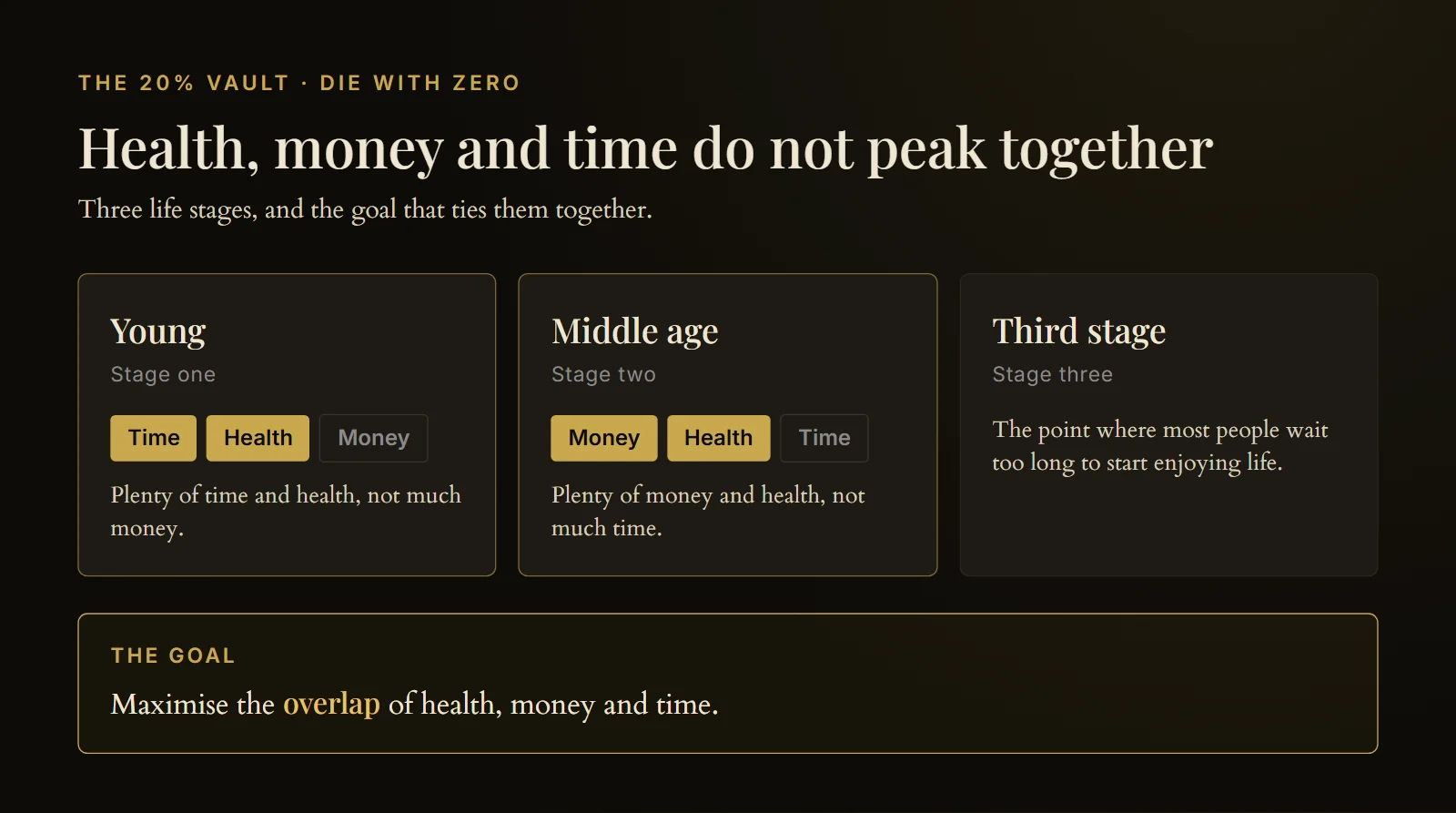
Both reviews describe the same trade-off: three resources that shape a full life. Money Hacking Mama summarises the stages like this:
- Young: time and health, but not much money.
- Middle age: money and health, but not much time.
- Third stage: the point where, per Money Hacking Mama, most people wait too long to start enjoying life.
The goal is to maximise the overlap of all three. Experiences that need physical energy, such as a long trek or a demanding adventure, fit the years when health is still high. Experiences that need money and time fit later. The mistake is assuming the three will all peak together. They do not.
Physician on FIRE sets out the same idea as time buckets, with ages 20 to 40 (little wealth, lots of energy and time), 40 to 70 (more wealth, less time and energy), and 70 and up (less energy and mobility, more wealth and time). The two reviews do not agree on exact age bands, so treat the numbers as a rough guide, not a rule.
The Time Buckets Exercise
The practical version is simple:
- Divide the next 20 to 40 years into buckets of years.
- List the experiences you want, not just the things you want to buy.
- Assign each experience to the bucket where it fits best, given your health, relationships and energy at that age.
This is the step most people skip. A bucket list with no dates stays a wish. A bucket list with dates is a schedule.
Physician on FIRE reports that life expectancy "typically exceeds 80 years", and says to use your wealth for a positive impact now, such as giving to charity or an early inheritance for your children. The page gives no age for that inheritance.
Peak Net Worth and the Decumulation Question
Physician on FIRE says the book advises identifying your "peak net worth", then deliberately stopping active wealth-building and spending down. The review gives no threshold for when to do this, and I would not treat any number as one.
The honest version of this step is harder than it sounds. Decide what the money is for first, then work out how much you need to fund it. Do not pick a balance because it feels safe and then look for things to spend it on.
Actionable Takeaways
- Audit your life against health, money, and time. Where are you over-indexing on money at the expense of the other two?
- Build decade buckets for the next 20 to 40 years. Assign each experience to the bucket where it fits best, not to "someday".
- Front-load what needs your body. Put the physically demanding experiences in the years you still have the energy for them.
- Track memory dividends. After each experience, note the stories and shared moments it produces. That is where the return shows up.
- Define "enough" in experiences, not in a balance. In my use, the question "what will I regret not doing?" is a better guide than "what number feels safe?"
Teaser GPT Prompts
Curious how the framework applies to your own life? Try these prompts:
- "I'm 34 with $80,000 saved and a stable income. Based on Die With Zero's time-bucket framework, which experiences should I prioritise in the next 10 years before health or energy constraints hit?"
- "Ask ChatGPT: How would Bill Perkins redesign my retirement plan if I'm saving 30% of my income but deferring all travel and big experiences until I'm 65?"
- "I have a bucket list of 20 items. Help me assign each to a 5-year time bucket based on when I'll get the most value from it, considering health, relationships and memory dividends."
The Catch: This Book Isn't for Everyone
One Goodreads reviewer says the book is written for high-income over-savers and can be harmful outside that group. If you are still building an emergency fund or struggling to save for retirement, that caution applies. The framework assumes you are already on track financially and need permission to spend.
Perkins is not saying spend your savings. That distinction matters. Build the foundation first. Once you are there, the framework helps you avoid the opposite extreme: dying rich with a life full of deferred experiences.
Sources and Limits
- Physician on FIRE, "Die With Zero Book Review": time buckets, the three resources, memory dividends, peak net worth, life expectancy and early-inheritance giving.
- Money Hacking Mama, "Die With Zero Summary": the experience curve, the overlap goal, the three life stages, the "running out of life" framing.
- Goodreads book page: reader reviews, including the high-income caveat.
I did not open the book itself. Every book-level claim here comes from these three pages, and the reviews do not agree on every number.
Want more frameworks like this? The Almanack of Naval Ravikant covers wealth-building from a different angle: leverage, specific knowledge, and permissionless systems. Psychology of Money dives deeper into why wealth is behaviour, not maths. And Atomic Habits shows how small systems compound into big outcomes.
The next synthesis, the week it drops.
Distilled, not summarized. Free.
Free. No spam.